
Harpsichords age. Over 270 years, the wood of a soundboard changes how strongly it damps its own vibration – and with it, the sound.
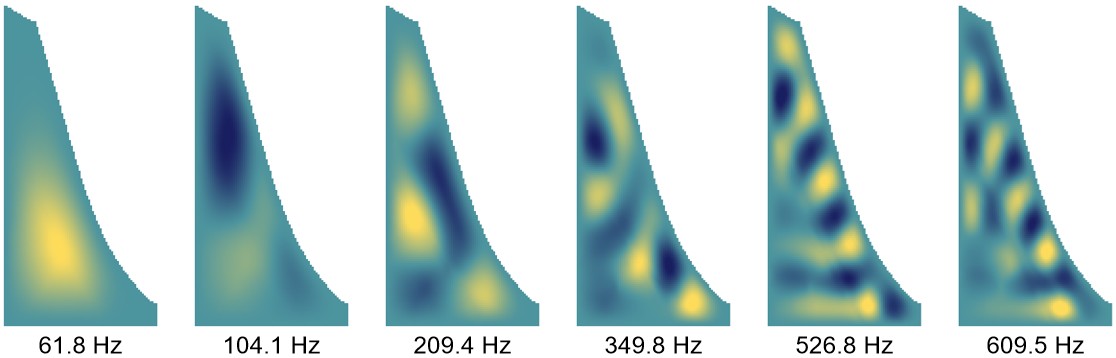
We studied a harpsichord built by Johannes Daniel Dulcken in Antwerp in 1755 and asked two questions: how much do simple changes in damping, as they happen through aging, change the sound? And what role does the instrument’s unusual double bentside play in holding the soundboard under tension?
A virtual Dulcken
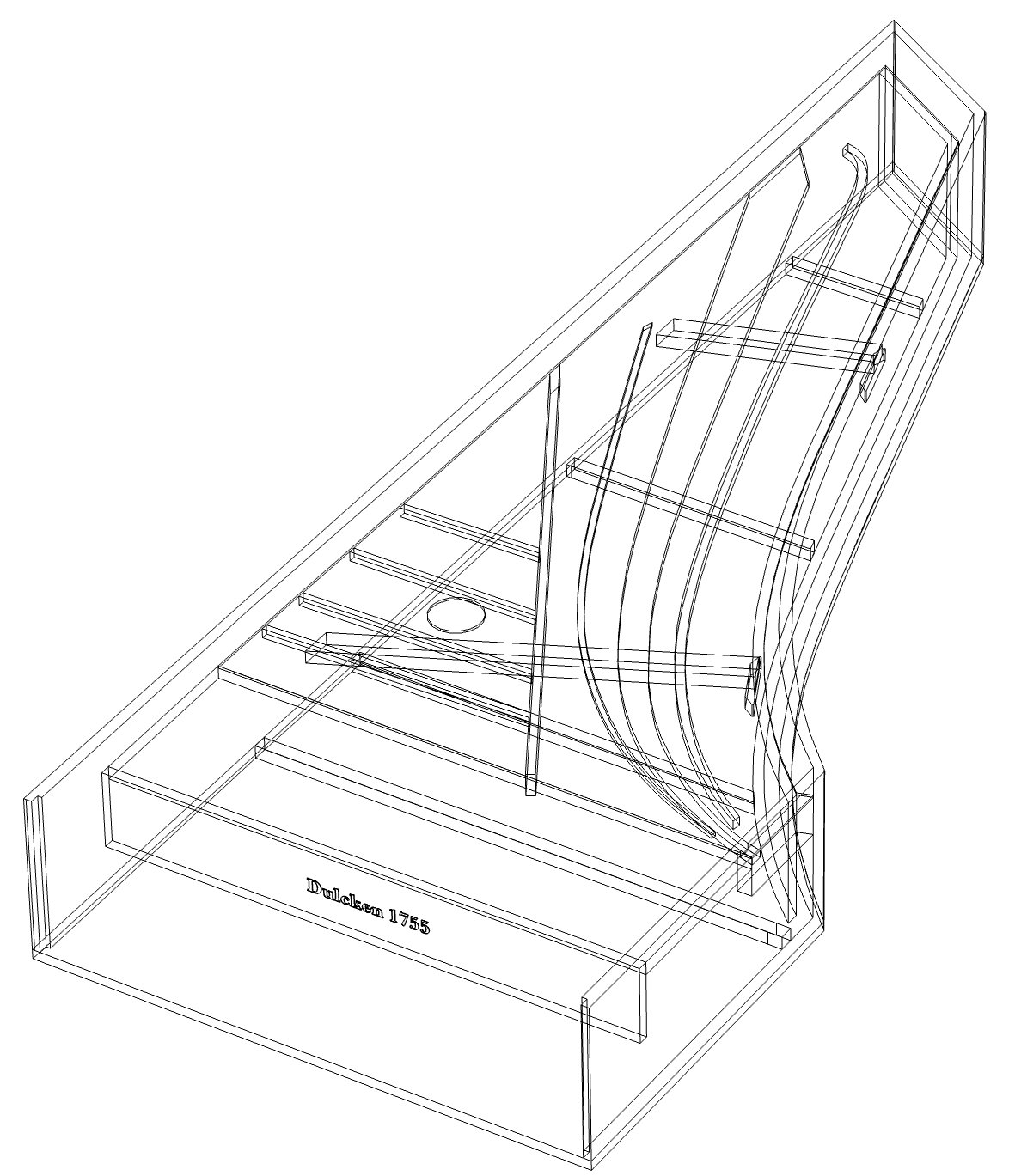
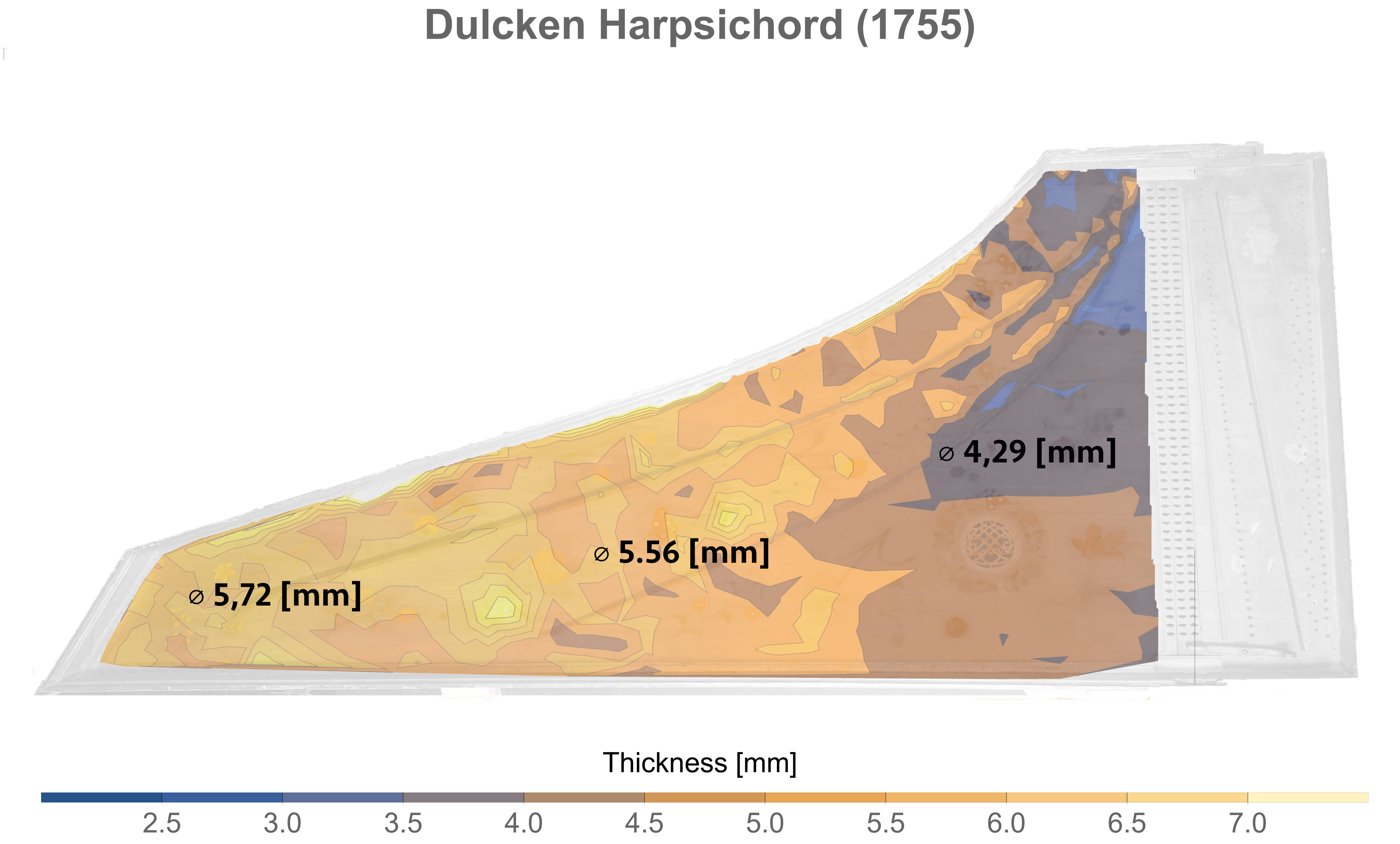
From measurements of the original, we built a complete physical model of the 1755 Dulcken – soundboard, 8′ and 4′ bridges, cross-bar, ribs and strings – that runs on graphics processors (GPUs). In the computer, wood and construction can be changed one at a time: the stiffness of the soundboard (Young’s modulus), its internal damping, the bridge height and the heights of cross-bar and ribs. 225 virtual Dulckens were built this way. On each, all C and F keys of the 8′ and 4′ registers were plucked and the bridges knocked – 8,100 sounds, analysed with ten psychoacoustic features and machine learning.
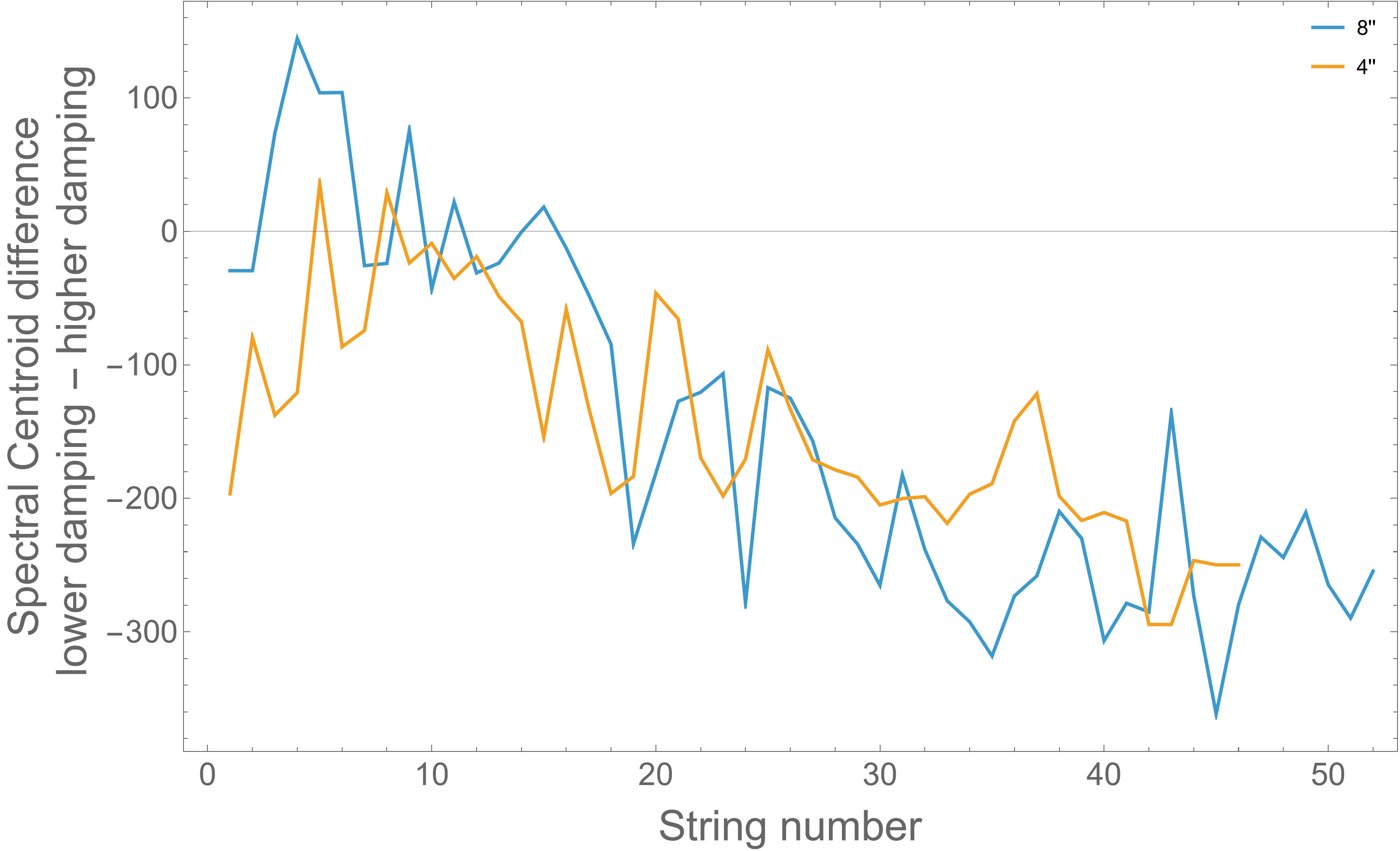
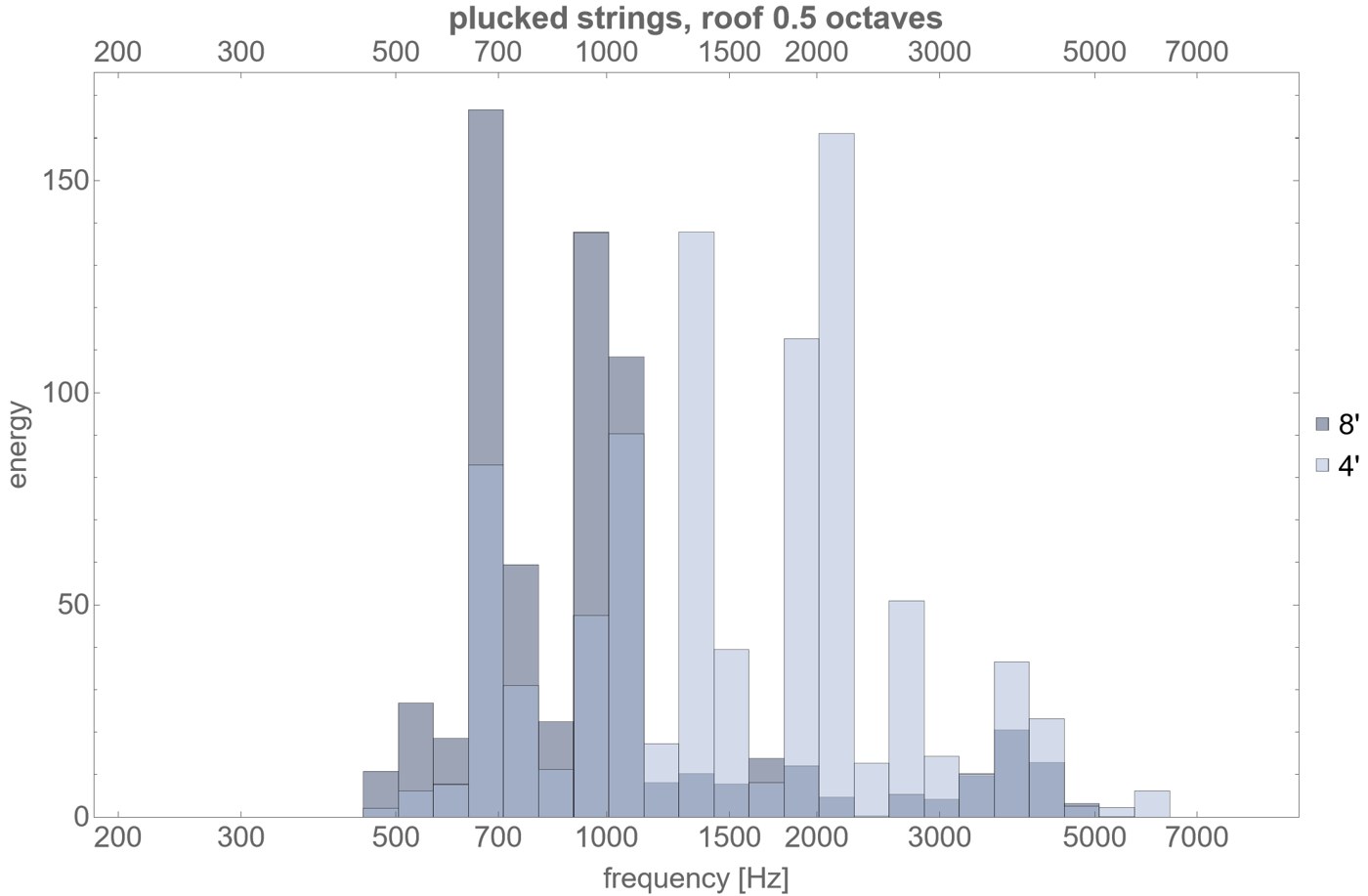
What we found. Construction and sound are related in a highly complex way: machine learning finds no simple groups. A few rules are clear. Changing the internal damping shifts brightness consistently across registers and keys; a stiffer soundboard changes it too, but unevenly, because soundboard and bridges interact. And like a voice, the harpsichord has formants – frequency regions it always emphasises: around 1 kHz for the 8′ register and around 2 kHz for the 4′ register.
Literature
Bader, R., Plath, N. & Kontopidis, P.: Sound impact of simple viscoelastic damping changes due to aging and the role of the double bentside on soundboard tension in a 1755 Dulcken harpsichord. arXiv:2511.09037, 2025. https://arxiv.org/abs/2511.09037
Beurmann, A., Bader, R. & Schneider, A.: An acoustical study of a Kirkman harpsichord from 1766. Galpin Society Journal LXIII, 61-72, 2010.
Bader, R.: Vibrational Analysis of the Soundboard of a Kirkman Harpsichord of 1766 Using Microphone Array Techniques. In: Analysis and Description of Musical Instruments Using Engineering Methods, Händel-Haus Halle, 133-139, 2011.
Recent Comments